[Intro]
C
[Chorus]
C
What am I gonna do
C
When I get over you?
G
What am I gonna be
C
When you're just a memory?
C
What am I gonna drink
F G C
When I don't have to think about what I'm gonna do without you?
[Verse 1]
F G C
Been drinkin' everythin' on that shelf
F G C
Feels like I'm killin' myself
F G C
You're gone and it hurts like hell
F
Wishin' I was anybody else
[Chorus]
C
What am I gonna do
C
When I get over you?
G
What am I gonna be
C
When you're just a memory?
C
What am I gonna drink
F G C
When I don't have to think about what I'm gonna do without you?
[Guitar Solo]
Dm Am Dm G C
[Verse 2]
F G C
Jukebox with a neon glow
F G C
Keeps playin' "That's The Way Love Goes"
F G C
Time keeps tickin' on by so slow
F
They say it'll heal you, but I hope it don't though
[Chorus]
C
What am I gonna do
C
When I get over you?
G
What am I gonna be
C
When you're just a memory?
C
What am I gonna drink
F G C
When I don't have to think about what I'm gonna do without you?
[Outro Guitar Solo]
Bb F C Bb F C Bb F C
Bb F C
How to play "What Am I Gonna Do" Chords on acoustic guitar
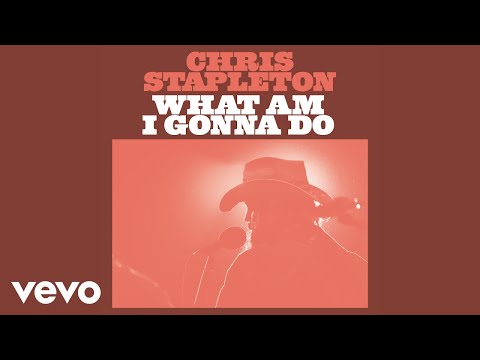
Chris Stapleton is playing the 'What Am I Gonna Do' tabs / chords in the
music video.
Key: C major. Capo: none. Tuning: standard (E A D G B E). Difficulty: easy
with one barre chord (Bb). This Guitar Lesson focuses on a steady halftime feel
and clean chord changes.
Chords Used
All shapes are open-position except Bb. Use the easier Bb if needed.
C (x32010) C: x32010
G (320003 or 320033) G: 320003
F (133211) easy: xx3211
F: 133211
Dm (xx0231) Dm: xx0231
Am (x02210) Am: x02210
Bb (x13331) easy no-barre: xx3331
Bb: x13331
Strumming Pattern
Halftime pulse around 63 bpm (album tempo roughly 126 bpm, counted
in halves).
Beginner-safe pattern: D D U U D U. Count it as 1 2 and and 4 and. Let beat 3
hit like a backbeat accent by strumming a slightly stronger D on that spot. Keep
your fretting hand relaxed and let chords ring. Aim for light pick attack; save
heavier dynamics for the chorus.
Pattern guide (4 bars):
| D   -   U   U   D   U | D   -   U   U   D   U |
| 1   2   &   &   4   & | 1   2   &   &   4   & |

Dynamic tip:
Verse = gentle; Chorus = medium; Outro = gentle again.
Sections Breakdown
Intro (1 bar each): C C then into Verse 1. Light downstrokes.
Optional walk shown below.
Simple C-bass walk into G:
e|----------------|
B|----------------|
G|----------------|
D|----------------|
A|-3--2-----------|
E|-------3--------|
Counts:    4  &       1
Verse progression (lyrics cues omitted):
C  | G  | C  | F  G  | C  | F  G  | C  | F  G  | C  |
Keep the halftime feel. Let F to G breathe; do not rush the change.
Turnaround (after first chorus):
Dm | Am | Dm | G | C |
Hold each chord for one bar. Keep right hand moving lightly.
Chorus progression (each bar):
C | F  C | G | C |
On "drink / think" lean the accent into beat 3 for the lyric lift.
Bridge ("Jukebox with a neon glow"):
F | G | C | F | G | C |
Stay on the groove; resist over-strumming. Keep vocals front and center.
Outro tag (last passes):
Bb | F | C | Bb | F | C |
If full Bb barre is tough, use xx3331. Keep volume tapering down.
Common Mistakes
Small fixes make the groove lock in.
Rushing the halftime pocket. Count 1 2 and and 4 and; let space
happen on the dashes. The song breathes.
Heavy strum on verses. Use a lighter pick grip and aim for the
top four strings on C and F to thin the texture.
Gripping the Bb barre. Angle the index slightly toward the nut,
roll onto the bony edge, and keep the thumb relaxed. Or play xx3331.
Choppy chord tails. Keep the strumming hand moving even when you
mute for dynamics; motion equals timekeeping.
General Tips
Tuning. Standard. Fresh strings help the sustained halftime groove.
Capo ideas. If Bb is rough, capo 5 and play G shapes
(G C D Em Am). You will match the key of C while avoiding a full barre.
Voicings. For F, try xx3211 to avoid the 6th-string root; it
sits nicer under the vocal.
Tone. Aim for warm strums near the soundhole. Fingerpick the intro
if you want a softer entrance.
Practice loop. Loop Verse to Chorus twice at 60 to 65 bpm, then
bump toward album feel.
Attribution. For chord reference, compare multiple chord resources
and your ear to the studio cut.
Song Facts:
Chris Stapleton opened his 2023 album "Higher" with "What Am I Gonna Do," a
soulful slow-burn written with Miranda Lambert. Editorial notes for the album
highlight the track as the opener and frame the record as a wide-ranging blend
of country, Southern rock, and soul, co-produced by Dave Cobb and Morgane
Stapleton. The song’s tempo sits around 126 bpm in the studio, but most players
feel it in halftime near 63, which is why that laid-back pocket works so well on
acoustic. Multiple key-detection and catalog sites list the track in C major,
matching what you will hear if you play open C, F, and G shapes along with the
official audio.
Stapleton has performed the song in notable live settings since the album
release, including network TV and award-show stages, where the intimate lyric
lands even more directly than on the record. Reviewers pointed to "What Am I
Gonna Do" as a thesis statement for the album’s themes: heartbreak, endurance,
and the complicated comfort of time. Credits typically list Stapleton and
Lambert as writers, and Apple’s album entry places the track as the opener on
"Higher" with a runtime around three minutes. For learners, these facts boil
down to three practical takeaways: lock the halftime feel, use open-position
chords in C, and shape dynamics so the voice remains the focal point.
Song Meaning
The song wrestles with the paradox of healing. The narrator imagines life
after the sting fades and wonders who he will be without the pain. Verses sketch
the day-to-day blur; the chorus asks existential questions in plain language.
The turnaround’s minor move (Dm to Am) gives you that sag before landing on G,
a musical sigh that sets up the chorus. In the bridge, the barroom imagery and
slow clock amplify the emotional stasis. The closing Bb F C tag adds a touch of
gravity, then releases you back to C, like acceptance after a long exhale.
Comparisons to previous works:
Like "Traveller," this track leans on open-chord Americana textures and vocal
weight rather than flash. Compared with "Starting Over," it sits more in a
barroom dusk than daylight hope. The halftime sway and stacked harmonies nod to
the Stapleton playbook, but the opener placement and Lambert co-write give it a
fresh frame. If you have played "Tennessee Whiskey," think less melismatic soul
and more measured storytelling over sturdy C F G moves.
Tutorial Mini-Checklist
Set a metronome near 63 bpm. Feel the backbeat before you strum.
Warm up C to F to G changes using D D U U D U for two minutes.
Practice the Dm Am Dm G C turnaround until it flows under 30 seconds.
Sub Bb with xx3331 if your barre collapses late in the song.
Record a one-take Verse to Chorus; listen for rushing after beat 2.
FAQ
What is the tuning and capo setup?
Standard tuning with no capo for album key C.
What is a simple strum that works?
D D U U D U at a halftime feel around 63 bpm.
Which chords appear in this song?
C, F, G, Dm, Am, and Bb. Use xx3331 for an easier Bb.
How do I keep time without rushing?
Count 1 2 and and 4 and, accent the downstroke on beat 3.
Is there a quick practice plan?
Loop Verse and Chorus at 60 to 65 bpm, then nudge toward record feel.
Tutorial note for learners: avoid copying full lyrics; use short cue
phrases and count time out loud.
How to play this effectively: keep your right hand moving, mute
lightly between sections, and aim for even tone. If your Bb buzzes, switch to
xx3331 until your hand strength grows.